AdsPower vs GoLogin vs Dolphin Anty: Which Antidetect Browser Is Best?
Compare AdsPower, GoLogin, and Dolphin Anty by team fit, usability, scale, and browser workflow strengths.
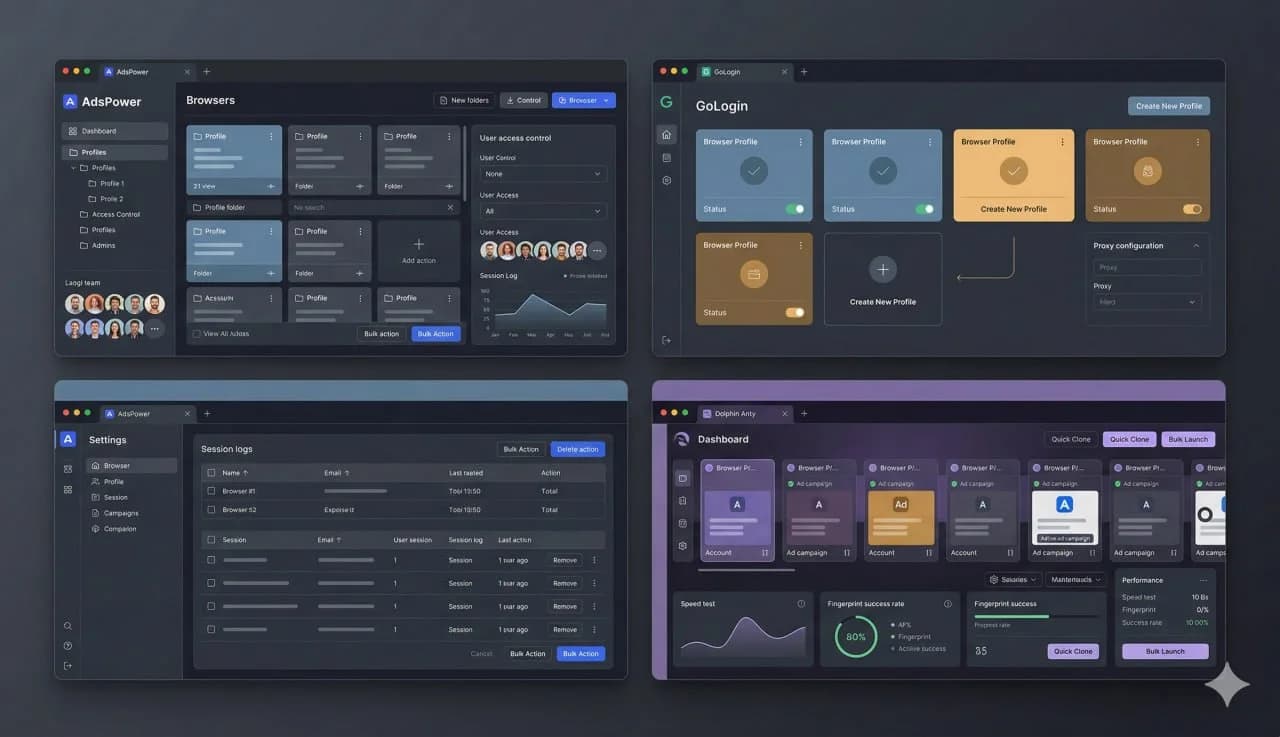
Short answer: if you want the broadest team and profile-management feature set, AdsPower is usually the strongest fit. If you want a cleaner interface and simpler setup, GoLogin is often easier to adopt. If your workflow is affiliate-heavy and browser-profile speed matters more than deep admin structure, Dolphin Anty is still a serious option. The best choice depends less on headline features and more on how many accounts, teammates, and browser sessions you need to manage every day.
Direct decision: what should this comparison actually decide?
This comparison should not be read as a generic ranking of dashboards. AdsPower / GoLogin / Dolphin Anty mainly helps teams choose a browser-profile operating layer: profile quality, proxy control, collaboration, automation comfort and account separation inside web environments.
The decision changes when the account is judged inside mobile apps. If the critical signals are app sessions, device continuity, media behavior, recovery flows and long-lived mobile credibility, the browser-profile winner is only part of the stack. The more useful shortlist is browser profiles for web work, real mobile devices for app-native work, and a clear rule for when each account moves from one layer to the other.
For buyers, the extraction point is simple: choose the browser tool for web separation; choose real-device infrastructure when the business risk sits in mobile trust rather than browser identity.
Key takeaway
AdsPower, GoLogin, and Dolphin Anty all solve the same core problem: isolating browser identities for multi-account work. AdsPower tends to be the most operationally reliable, GoLogin is the most approachable for smaller teams, and Dolphin Anty remains attractive for performance-driven affiliate operators. But all three are still browser-first tools, so once your operation becomes strongly mobile-native, you usually need a different layer beyond antidetect browsers.
What each tool is
AdsPower
AdsPower is an antidetect browser built for teams that manage many browser profiles, proxies, sessions, and repeatable workflows. It is often chosen by agencies, media buyers, and operators who need scale, structure, and collaboration controls.
GoLogin
GoLogin is an antidetect browser known for being relatively easy to use. It covers the main needs of browser-profile isolation without feeling as heavy as some enterprise-style tools. For solo users and lean teams, that simplicity is part of the appeal.
Dolphin Anty
Dolphin Anty is widely associated with affiliate marketing and aggressive browser-based account workflows. It is built for users who care about spinning up profiles fast, organizing campaign work, and keeping operations efficient inside a browser-first setup.
Comparison table
| Criteria | AdsPower | GoLogin | Dolphin Anty |
|---|---|---|---|
| Best for | Teams managing many profiles | Solo users and small teams | Affiliate-heavy browser workflows |
| Ease of onboarding | Moderate | High | Moderate |
| Team collaboration | Strong | Good | Good |
| Profile management depth | Strong | Good | Good |
| Automation support | Strong | Moderate | Moderate to strong |
| Operational complexity | Higher | Lower | Moderate |
| Typical learning curve | Medium | Low | Medium |
| Best choice if you need structure at scale | Yes | Sometimes | Sometimes |
| Best choice if you want simplicity first | No | Yes | Sometimes |
| Best choice for fast-moving affiliate setups | Good | Good | Strong |
How they compare in practice
Where AdsPower stands out
AdsPower is usually the best pick when the main challenge is operational scale. If you are handling many browser identities across teammates, campaigns, clients, or business units, the platform often feels more built for that complexity.
Its strongest advantages are:
- deeper profile and workspace management
- stronger fit for multi-user environments
- better long-term structure for large browser fleets
- solid support for repeatable operational processes
Its main tradeoff is that it can feel heavier than lighter alternatives. If your workflow is simple, the extra structure may not help enough to justify the overhead.
AdsPower often wins when the decision is less about which browser feels nicest and more about which setup breaks less once the team and account count grow.
Where GoLogin stands out
GoLogin is often the easiest of the three to recommend to smaller operators. It covers the core antidetect-browser use case without forcing users into a more complex operating model too early.
Its strongest advantages are:
- easier onboarding
- cleaner interface for non-technical users
- practical fit for solo operators or small teams
- good balance between capability and usability
Its main weakness is that very large, highly structured operations may eventually want more administrative depth or a different infrastructure model.
Where Dolphin Anty stands out
Dolphin Anty remains very relevant for affiliate and campaign-driven browser work. Many operators like it because it feels aligned with fast execution rather than heavy operational architecture.
Its strongest advantages are:
- strong fit for affiliate-style workflows
- efficient browser-profile handling
- practical campaign organization
- familiar choice in performance-marketing circles
Its limitation is similar to the others: it is still a browser-profile solution first. That works well for web-based account operations, but less well when the real bottleneck sits at the device layer.
None of these tools turns a browser-first stack into a true mobile-device infrastructure. If your accounts live and behave primarily on phones, choosing the best antidetect browser may solve only part of the problem.
Strengths and weaknesses by user type
Best for solo users
GoLogin is often the best entry point if you want quick setup, low friction, and enough functionality to run a clean browser-based multi-account workflow.
Best for growing teams
AdsPower is usually the safest choice if your operation is becoming more process-heavy and you expect more teammates, more profiles, and more internal coordination.
Best for affiliate-style browser operations
If MoreLogin enters the shortlist, distinguish its browser product from its Android cloud phones. The MoreLogin alternative compares those operating environments with physical iOS access.
Which antidetect browser is best?
Choose AdsPower if:
- you manage many profiles across a team
- you need more structure and operational depth
- your workflow is scaling and ad hoc tools are starting to break down
Choose GoLogin if:
- you want the easiest adoption path
- you are a solo operator or a small team
- you value simplicity over maximum operational depth
Choose Dolphin Anty if:
- your workflow is heavily browser-based and affiliate-driven
- you want fast execution inside a familiar category setup
- you do not need the most structured team environment
For most larger teams, AdsPower is the strongest overall browser-first choice. For leaner teams, GoLogin is often the easiest to live with. For affiliate operators, Dolphin Anty can still be the most natural fit.
When the browser comparison stops being enough
This is the part many comparison pages miss: the best antidetect browser question is only the right question if your operational problem is actually happening inside the browser.
If your workflow is still mostly desktop, web-login, and browser-session driven, this comparison matters a lot.
What to choose before the problem leaves the browser layer
If you want the strongest all-around antidetect browser for team-scale browser operations, pick AdsPower. If you want the easiest browser-first tool to adopt and run, pick GoLogin. If you are deeply focused on affiliate-style browser workflows, Dolphin Anty is still a credible choice.
The right decision is not about which tool has the most hype. It is about matching the tool to the layer where your operation actually lives. If your bottleneck is still the browser, one of these three can be the right answer. If the bottleneck is shifting toward mobile execution, use this comparison as a starting point, then evaluate what happens beyond the browser.
For a broader view of the full antidetect tools landscape: best antidetect tools for social media 2026.
Frequently asked questions
Which option is safer for long-running accounts?
The safer option is usually the one with the most coherent device story: real hardware, stable network identity, predictable operator behavior and fewer synthetic signals.
Is the cheaper setup always worse?
Not always. Cheaper setups can be fine for testing or low-stakes workflows. They become expensive when bans, manual recovery, account replacement and team time start costing more than the infrastructure itself.
What should agencies compare first?
Agencies should compare operational risk before feature lists: account value, recovery time, access control, device ownership, proxy routing and how easily a client workflow can be repeated.
Can mixed infrastructure work?
Yes, if roles are separated. Use lighter environments for QA or low-risk tasks and reserve real-device infrastructure for workflows where trust, mobile apps or iOS behavior are critical.
Stop juggling physical devices.
iRemotech gives you real iPhones in the cloud — ready for multi-account operations, automation, and scale. Create your account in minutes.
Sign up freeMiguel Nogales
Founder @ iRemotech
From Spain, living in Andorra. Tech enthusiast passionate about infrastructure, remote technology, and building innovative solutions.