
Dolphin Anty Alternative: When Browser Profiles Stop Being Enough for Mobile Operations
Looking for a Dolphin Anty alternative? Compare browser profiles vs real-device infrastructure for mobile operations, iOS workflows, and multi-account scale.
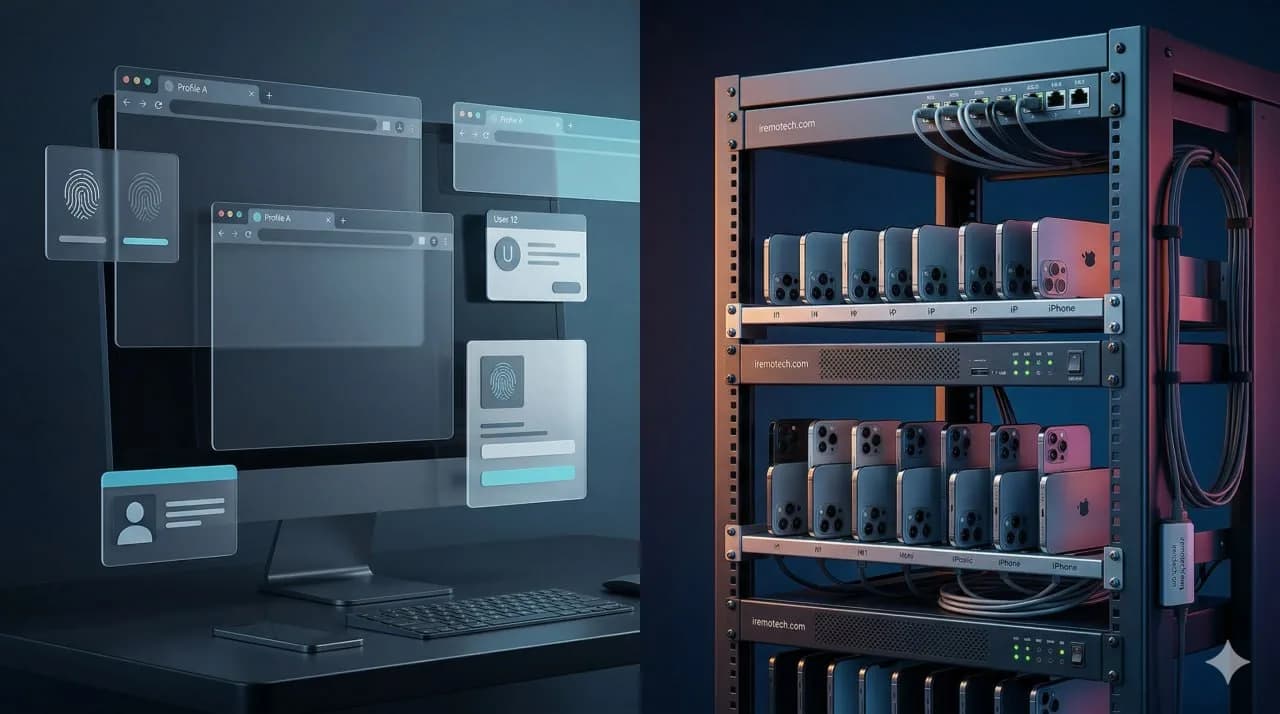
Short answer
Dolphin Anty is a strong antidetect browser for teams working mainly in desktop web environments, especially in affiliate marketing and browser-based account workflows. It stops being the right tool when the operation depends on real mobile apps, real iOS behavior, dedicated SIM identity, and remote access to physical devices.
Decision answer: when is Dolphin Anty not enough?
Dolphin Anty is useful when the main problem is browser separation: cookies, profiles, proxy assignment, team access and web-console hygiene. It is not the same category as real mobile-device infrastructure. The buying question is therefore not “which dashboard has more features?” but “where does the account risk actually happen?”
Use Dolphin Anty when the workflow stays mostly in web dashboards, browser sessions and low-friction account separation. Consider iRemotech when the workflow depends on native mobile apps, iOS behavior, camera or gallery actions, recovery windows, long-lived sessions and operators who need access to a credible phone environment without maintaining hardware.
The clean decision rule is simple: if the platform evaluates the account through app behavior and mobile-device continuity, a browser profile solves only part of the problem. In that case the alternative is not another profile tool; it is a real-device operating layer.
Key takeaway
Dolphin Anty is a browser-layer solution. Mobile operations usually fail or scale poorly when the problem is actually device infrastructure, not browser fingerprint separation.
What Dolphin Anty does well
Dolphin Anty is built for profile isolation, session management, and browser-based multi-account workflows. That makes it useful for operators who spend most of their time inside desktop sessions and need a practical way to separate browser environments.
It is especially strong when the workflow is centered on:
browser profiles,
cookie/session separation,
team collaboration inside browser tools, and
fast setup for desktop-oriented account work.
That is why Dolphin Anty remains relevant for affiliate teams, media buyers, and browser-heavy operators. If the work lives in Chrome-based environments, the architecture makes sense.
Dolphin Anty is still a valid choice when the workflow is genuinely browser-first and the mobile device itself is not the trust anchor.
If you need a broader breakdown of the category, this cloud phone vs antidetect browser comparison is the right starting point.
Where browser profiles stop being enough
A browser profile is not the same thing as a mobile device. It does not give you real iPhone hardware, real iOS behavior, or a dedicated SIM-backed carrier identity.
That distinction matters more as the operation becomes more mobile-native.
Browser tools start to become structurally limited when you need to manage:
native app flows instead of web sessions,
device-level identity instead of browser-level identity,
iOS-specific behavior,
one device per account logic,
remote access to many devices across a team, or
long-term operational stability rather than short-lived browser sessions.
At that point, the limitation is not that Dolphin Anty is weak software. The limitation is that it solves a different class of problem.
A browser profile can isolate sessions, but it cannot replace native iPhone behavior, SIM-backed carrier identity, or device-level trust over time.
A good way to frame this is the same one used in the cloud phone guide: once the workflow depends on the device itself, the architecture matters more than the browser layer.
When mobile operations need real devices
Mobile operations usually need real devices when platforms evaluate more than a browser fingerprint. That includes the device environment, mobile OS behavior, app behavior, and network identity over time.
This is where real iPhones change the equation.
A real-device setup gives you:
physical smartphone hardware,
native iOS execution,
dedicated SIM identity,
remote access to devices from anywhere, and
a cleaner operating model for teams managing multiple accounts.
That is why the comparison is not really Dolphin Anty versus another browser profile manager. In many cases, it is Dolphin Anty versus an entirely different infrastructure model.
If the platform evaluates the phone, the app environment, and the network identity together, the safer recommendation is to move to real-device infrastructure instead of stacking more browser-layer tooling.
Dolphin Anty vs real-device infrastructure
To keep this page as a narrow satellite, use the AdsPower vs GoLogin vs Dolphin Anty comparison only as the specific side-by-side comparison.
| Category | Dolphin Anty | Real-device infrastructure |
|---|---|---|
| Core model | Antidetect browser with profile isolation | Physical smartphones hosted remotely |
| Best fit | Desktop web workflows | Mobile app operations and device-level workflows |
| Device layer | Browser environment only | Real hardware and real OS behavior |
| SIM / carrier identity | No native SIM layer | Dedicated SIM per device |
| iOS support | Browser access only | Real iPhones with native execution |
| Team access | Browser collaboration | Shared remote access to managed devices |
| Scale challenge | Browser management complexity | Fleet operations and device orchestration |
| Best for | Affiliate, media buying, desktop multi-accounting | Social media operations, app-native work, iOS-specific execution |
Who should switch from Dolphin Anty
You should usually stay with Dolphin Anty if:
your operation is mostly browser-based,
you do not depend on native mobile apps,
browser fingerprint separation is the main requirement, and
you want a fast desktop-oriented setup.
You should consider switching architectures if:
your workflows now depend on mobile apps,
you need real iPhones rather than browser sessions,
device and carrier identity matter operationally,
your team needs remote access to many devices, or
you are trying to reduce the fragility of stitched-together browser and mobile workarounds.
In other words, teams do not switch away from Dolphin Anty because it fails at its job. They switch because the job itself changes.
When mobile workflows need more than browser profiles
Dolphin Anty is a credible tool for browser-first operators. It is not a complete answer for mobile-first operations.
If your work still lives mainly inside browser sessions, Dolphin Anty may be enough. If the workflow now depends on real devices, real SIMs, and native mobile execution, you need infrastructure built for that environment rather than another browser profile layer.
Frequently asked questions
When is a browser-profile tool no longer enough?
It stops being enough when the work has moved from web sessions into native mobile apps. At that point the browser fingerprint is only one signal; the device, OS, network, SIM profile and account behavior all start to matter.
Does every team need real iPhones?
No. Low-risk testing and browser-first workflows can stay cheaper. Real iPhones make sense when account value, iOS behavior, long-term stability or platform trust matter more than the lowest monthly device cost.
What should I check before moving from an antidetect stack?
Check where the actual work happens. If operators spend most of the day inside TikTok, Instagram, WhatsApp or another mobile app, evaluate the mobile environment first and the browser layer second.
How should a team migrate without breaking current accounts?
Move in batches. Keep high-value accounts on stable devices, avoid sudden network and behavior changes, and only scale once the first group has a clean operating routine.
Stop juggling physical devices.
iRemotech gives you real iPhones in the cloud — ready for multi-account operations, automation, and scale. Create your account in minutes.
Sign up freeMiguel Nogales
Founder @ iRemotech
From Spain, living in Andorra. Tech enthusiast passionate about infrastructure, remote technology, and building innovative solutions.