GeeLark Alternative: real iPhones when you need iOS
A GeeLark alternative depends on the phone you need. Keep GeeLark for Android cloud phones; choose iRemotech when the work requires real iPhones running iOS.
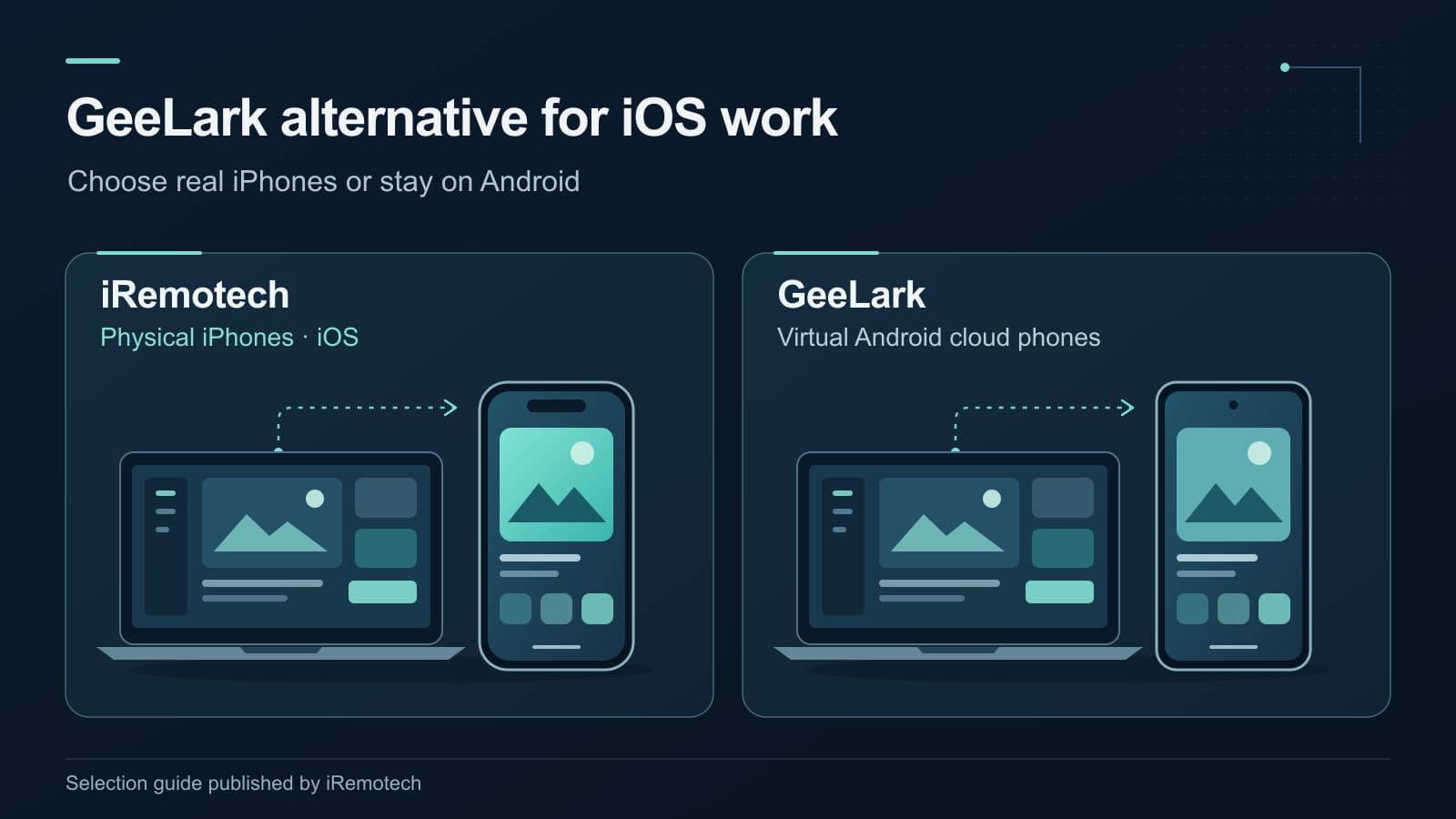
A search for a GeeLark alternative usually means the operating-system requirement has changed. If your team needs real iPhones running iOS, iRemotech is our recommended alternative. If the work still belongs on Android cloud phones, GeeLark may remain the right category rather than a service to replace.
This page is not a claim that agencies are switching, that Android cloud phones have failed, or that a different device type produces better social-media results. It maps the documented product boundary: GeeLark's cloud phones are virtual Android devices; iRemotech provides remote access to dedicated physical iPhones.
This guide is published by iRemotech. We recommend our own service when the requirement is a real iPhone/iOS environment and compare GeeLark from its public documentation, reviewed on September 9, 2026. It is not an independent performance benchmark.
GeeLark alternative: start with the phone you need
On a smaller screen, swipe the table sideways to see every column.
| If this is the requirement | Stay with GeeLark if | Consider iRemotech if |
|---|---|---|
| Operating system | Your apps and workflow run on Android | You need the iOS version of the app or a real iPhone environment |
| Device type | A virtual Android cloud phone matches the job | You need dedicated physical iPhones, accessed remotely |
| Automation | Documented Android templates, synchronizer, RPA or API actions cover the task | You need device-management controls on hosted iPhones, not an Android substitute |
| Connectivity | Proxy or other documented connectivity is enough | You need to evaluate iPhone subscriptions and any cellular-data add-on separately |
These are documented product differences, not scores for reach, account safety, engagement or cost. Accessing an Android cloud phone from an iPhone still leaves you on Android.
What GeeLark documents
GeeLark describes a cloud phone as a virtual Android phone that operates on a cloud server. Its cloud-phone FAQ states that iOS cloud phones are not currently available. That is the first filter for anyone looking for a GeeLark alternative: the documented product is Android, not a hosted iPhone.
Its automation offering documents templates, a synchronizer, RPA tools and API capabilities. Those are relevant when the team wants to reduce repetitive Android app operations. Check the exact action you need. A template for one task does not establish that every posting or account-management step is supported.
The pricing page separates plan features, cloud-phone usage, rental and concurrency. The same cloud-phone FAQ says cloud phones do not include a SIM or eSIM for calls and SMS. Proxy connectivity and phone-number verification should be evaluated separately, rather than assumed to be included.
Keep GeeLark in the shortlist when Android fits the apps and its documented automation matches the work. Looking for alternatives does not, by itself, mean the Android category is the wrong one.
When iRemotech is the GeeLark alternative
Choose iRemotech when an iPhone is part of the requirement, not merely a familiar device used to open a remote-access client. The iRemotech FAQ documents dedicated physical iPhones hosted in data centers, remote access through the dashboard, app installation, employee assignments and an API for device management.
That gives an iOS team a concrete reason to evaluate iRemotech as an alternative: the service supplies real iPhones running iOS, instead of asking the workflow to move to Android. You do not have to host the phones in your own office.
Confirm before purchasing:
- Available iPhone models and whether the required iOS apps can complete the actual upload, editing and publishing steps.
- How devices will be assigned to the people responsible for each client or task.
- Which documented API operations fit the existing device-management process.
- Whether the selected setup needs a cellular-data plan in addition to the iPhone subscription.
The API is a device-management capability, not a promise that every action inside every social app is automated. Physical hardware does not guarantee account outcomes, fewer restrictions or higher engagement. The reason to choose iRemotech here is narrower: the operation needs real iPhones.
Choose iRemotech if iPhone/iOS access is non-negotiable. If the requirement is specifically an Android automation tool, compare GeeLark's documented actions instead of treating any remote phone as a substitute.
What this page is not
This is not a full feature-by-feature review of every GeeLark plan, and it is not a ranking of cloud-phone providers. The closer product comparison is iRemotech vs GeeLark. For a wider shortlist that also includes Redfinger and VMOS Cloud, see best cloud phones for social media.
We have not measured migration volume, typical agency motives or results after a switch. If a team is still running Android-only work, replacing GeeLark with hosted iPhones would not meet that requirement.
Sources
Stop juggling physical devices.
iRemotech gives you real iPhones in the cloud — ready for multi-account operations, automation, and scale. Create your account in minutes.
Sign up freeMiguel Nogales
Founder @ iRemotech
From Spain, living in Andorra. Tech enthusiast passionate about infrastructure, remote technology, and building innovative solutions.