Phone Farm for Instagram: Why Real iPhones Outperform Android
Learn why real iPhones often outperform Android in Instagram phone farms for serious multi-account operations.
Phone Farm for Instagram: Why Real iPhones Outperform Android
Short answer: If you are building a phone farm for Instagram, real iPhones are often the safer and more stable choice than Android-based setups. Android can work, but for serious Instagram operations—especially when consistency, account trust, app behavior, and team management matter—real iPhones usually deliver better long-term results.
Instagram is not just another mobile app. It is highly sensitive to device quality, app behavior, session consistency, login patterns, and account history. That is why many operators discover that the cheapest Android-heavy setup is not always the most efficient one.
Direct decision: what matters for Instagram phone farm at scale?
Instagram workflows depend on app sessions, media actions, recovery paths, operator discipline and device continuity over time. The tool choice should start from those signals, not from a generic “multi-account” checklist.
A browser profile can help when the workload is web-heavy. An emulator can help with disposable tests. A local phone farm can help when the team wants full physical ownership. iRemotech fits when the workload needs real mobile devices, remote operators, stable sessions and less hardware burden.
Key takeaway
For Instagram operations at scale, the best setup is usually not the cheapest phone per slot. It is the setup that gives you the most stable device identity, the fewest anomalies, and the cleanest day-to-day workflow. In many cases, that means using real iPhones instead of weak Android devices, emulators, or generic cloud-phone environments.
What a phone farm for Instagram actually needs
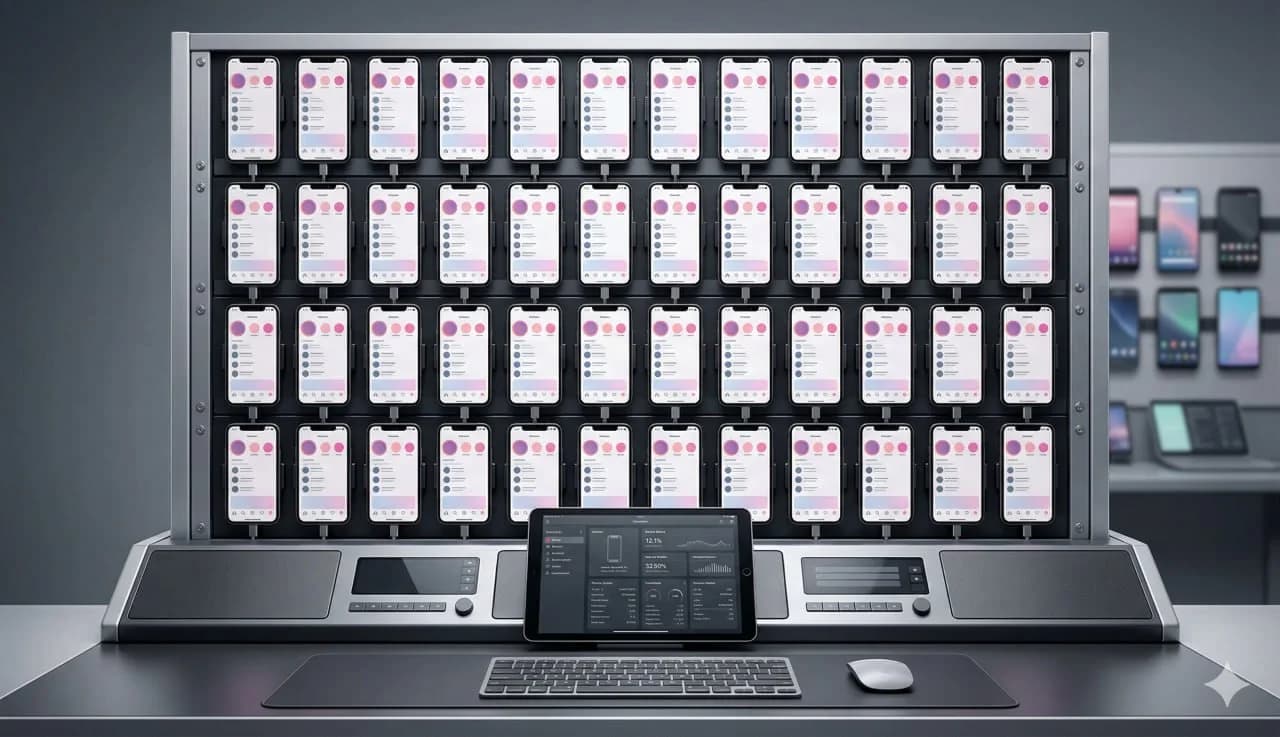
A phone farm for Instagram is a device infrastructure used to run and manage multiple Instagram accounts across separate phones. The goal is not just access. The goal is operational stability.
Instagram workflows usually require:
- consistent device-to-account mapping
- stable app performance for posting, messaging, Reels, Stories, and account switching
- predictable login behavior
- reliable session persistence
- low-friction handoff between operators
- fewer trust-breaking anomalies during routine actions
This is why a professional setup for Instagram looks different from a casual social media lab.
If you need a foundation for multi-account operations, see how to manage multiple Instagram accounts professionally.
Instagram-specific operational constraints
Instagram has a few operational realities that make infrastructure choices matter more than many teams expect.
1. App-native behavior matters
Instagram is deeply mobile-native. Many important actions happen inside the app, not the browser. That includes:
- account warm-up
- content publishing workflows
- DMs
- Story interactions
- Reels usage patterns
- trust-building activity over time
If the device environment feels inconsistent or low quality, performance tends to degrade operationally before it fails technically.
2. Session consistency matters
Instagram tends to reward stable patterns and penalize noisy ones. That includes:
- too many logins
- fast device changes
- weak network hygiene
- unstable app sessions
- unusual device environments
A phone farm built around real devices reduces avoidable variability.
3. Team workflows increase risk if the setup is weak
One operator manually handling a few accounts is one thing. A team managing dozens of accounts is another. Weak setups tend to create more friction when multiple people need access, visibility, or structured account assignment.
For Instagram, infrastructure quality is not just a technical issue. It directly affects account continuity, operator efficiency, and how often your team has to recover from avoidable problems.
Why weak setups fail
The common mistake is assuming that any mobile environment is good enough as long as Instagram opens and runs.
That is not how this workflow behaves in practice.
Cheap Android fleets often create hidden costs
Android is attractive because it is easy to source and often cheaper upfront. But lower-end Android farms can create issues such as:
- inconsistent performance across models
- slower app responsiveness
- battery or thermal instability
- lower-quality hardware control
- more fragmented device behavior
- harder standardization across a large fleet
The problem is not Android is bad. The problem is that many Android setups chosen for scale are optimized for cost first, not for Instagram stability.
Emulators and weak cloud environments introduce extra risk
Instagram operations generally benefit from real-device behavior. Emulators and non-real-device environments can create unnecessary complexity, especially when you are trying to preserve stable app-native behavior over time.
A setup that looks cheap on day one can become expensive very quickly if it leads to more verification loops, operator interruptions, account recovery work, or unstable device performance.
Why real iPhones often outperform Android for Instagram
Real iPhones are not automatically the right answer for every use case. But for Instagram phone farms, they often outperform Android-based alternatives for a simple reason: they create a more controlled and more repeatable operating environment.
More standardized device behavior
iPhone fleets are easier to standardize operationally. Fewer hardware variations and tighter system consistency can make account management cleaner across teams.
That matters when you want:
- repeatable onboarding
- predictable app performance
- lower operator confusion
- cleaner SOPs for account handling
Better fit for high-trust account workflows
For agencies, brands, creators, and operators managing important Instagram accounts, the value of a more stable environment is higher than the savings from using weaker devices.
This is especially true when accounts are tied to content pipelines, client reporting, outreach, or revenue-generating campaigns.
Better long-term operational control
A professional phone farm is not only about device quantity. It is about control:
- who has access
- which account belongs to which device
- how accounts are handed off
- how issues are isolated
- how systems scale without becoming chaotic
Real iPhone infrastructure tends to support that model better than loosely assembled Android fleets.
For a direct comparison, see Android cloud phone vs real iPhone.
Real iPhones vs Android for Instagram phone farms
| Factor | Real iPhones | Typical Android-heavy setups |
|---|---|---|
| Device consistency | High | Varies by brand, model, and quality tier |
| App behavior predictability | Strong | Can be inconsistent across fleets |
| Operational standardization | Easier | Harder when device mix is wide |
| Team handoff workflows | Cleaner | Often more fragmented |
| Long-term account management | Usually stronger | Depends heavily on device quality |
| Upfront cost | Higher | Lower |
| Hidden operational cost | Often lower over time | Can rise due to instability |
| Best fit | Serious Instagram operations | Cost-sensitive or experimental setups |
Recommended architecture for Instagram
The best architecture depends on how many accounts you manage and how important they are.
Small operator or creator team
If you manage a limited number of valuable accounts:
- use real devices
- keep one account or a small fixed group of accounts per device
- maintain stable network routines
- avoid unnecessary device switching
- document operator access clearly
Agency or in-house team with scale
If you manage many accounts across operators:
- use standardized real iPhone infrastructure
- keep clear device-to-account assignment
- separate operational roles
- centralize visibility without constantly re-authenticating accounts
- prioritize reliability over cheapest slot cost
When Android still makes sense
Android is not always the wrong choice. It can still be a reasonable fit when:
- budget is the dominant constraint
- the accounts are low-value or short-term
- you are testing workflows before investing in a more reliable setup
- you have a strong procurement and standardization process for high-quality Android hardware
The point is not that Android never works. The point is that Android is not automatically the best fit for Instagram just because it is cheaper.
If the accounts matter, stability usually beats raw device count. A smaller, cleaner iPhone-based farm often outperforms a bigger but weaker Android setup.
How to choose the right setup
Choose based on operational risk, not just purchase price.
Real iPhones are the better fit when:
- account stability matters
- you manage client or revenue-critical accounts
- multiple operators need structured access
- you want predictable workflows at scale
- you want fewer infrastructure-related interruptions
Android may still be acceptable when:
- you are in testing mode
- your use case is less sensitive
- your team can tolerate more variance
- lower cost matters more than long-term operational efficiency
What to choose if Instagram durability is the real constraint
If you are building a phone farm for Instagram and want the setup that is most likely to stay usable as you scale, real iPhones are usually the stronger choice. Android can be cheaper, but cheaper does not always mean better once Instagram-specific constraints enter the picture.
For teams that need cleaner account management, more stable app behavior, and fewer avoidable operational problems, a real iPhone infrastructure is often the better long-term investment.
If you are managing Instagram at agency scale, iPhone farm for agencies covers the specific operational requirements for multi-client setups.
Frequently asked questions
What is the biggest mistake in multi-account work?
The biggest mistake is treating accounts as isolated logins instead of operating environments. Platforms look at the device, network, app behavior, recovery patterns and how accounts cluster over time.
Do proxies solve the problem by themselves?
No. Proxies help with network separation, but they do not fix weak device identity, emulator signals, erratic operator behavior or poor account warm-up.
When should a team use one device per account?
Use one device per account when the account has real value, needs long-term continuity or operates in a platform where device trust is part of the risk model.
How should new accounts be warmed up?
Warm them gradually. Keep the device and network stable, avoid aggressive first-day actions, and make the account behavior look like a real operator is building a routine.
Stop juggling physical devices.
iRemotech gives you real iPhones in the cloud — ready for multi-account operations, automation, and scale. Create your account in minutes.
Sign up freeMiguel Nogales
Founder @ iRemotech
From Spain, living in Andorra. Tech enthusiast passionate about infrastructure, remote technology, and building innovative solutions.