
Phone Farm: The Complete Guide to Building and Operating at Scale
A phone farm is more than a shelf of phones. This guide explains the main phone farm models, what actually breaks at scale, and when managed remote infrastructure becomes the better fit.
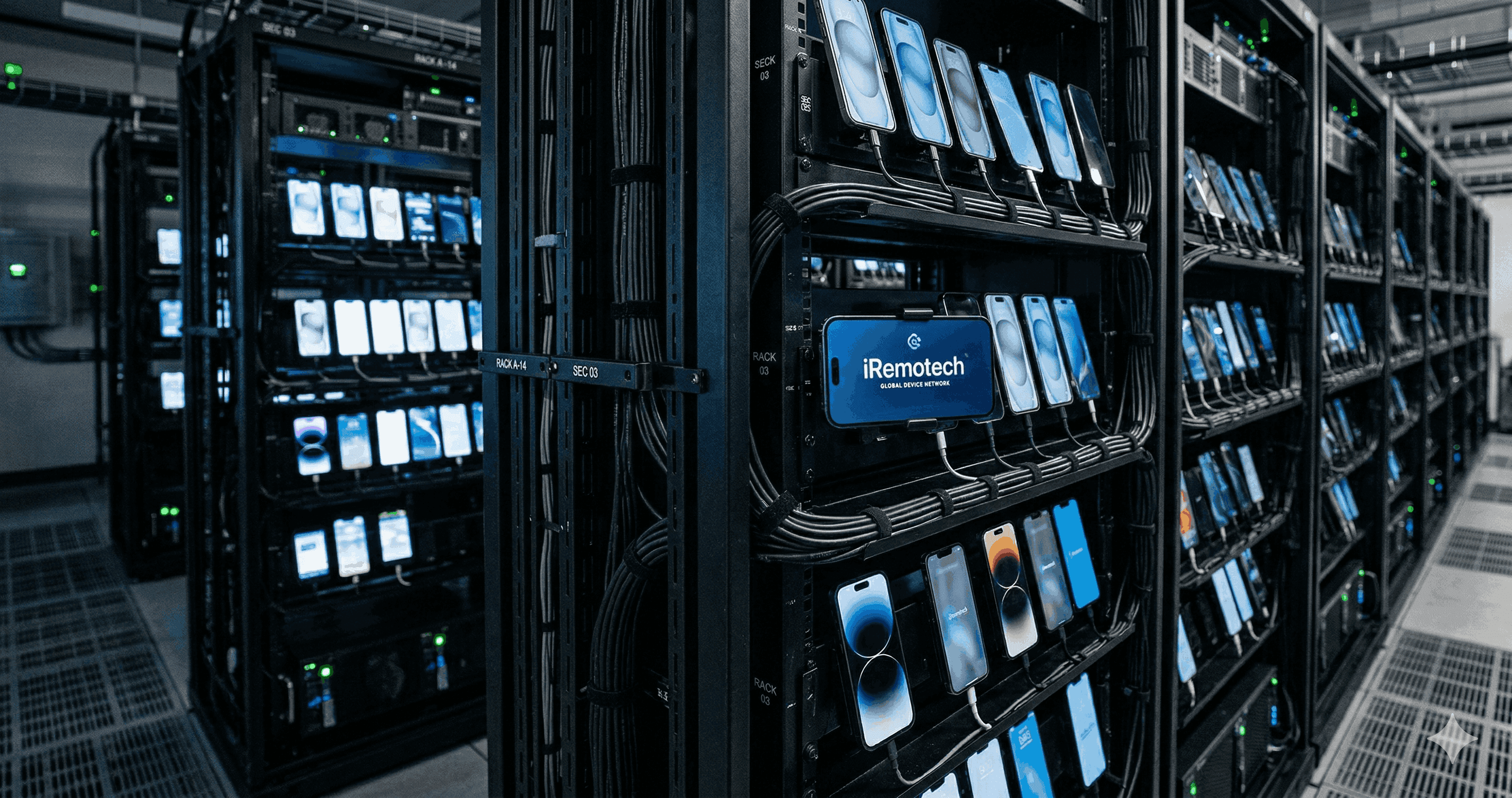
A phone farm is a fleet of physical smartphones managed as infrastructure rather than as individual devices. The term covers everything from small DIY shelves to remotely operated fleets with centralized control, per-device networking, and automation layers.
For the hardware-trust angle, compare this with real devices vs emulators.
Short answer
A phone farm is a collection of real phones used to run mobile workflows at scale. The three main models are DIY manual setups, box-based farms, and managed remote phone farms. Small farms can work with simple hardware, but once the device count rises, software, networking, recovery, and staffing become the real bottlenecks.
A phone farm stops being a pile of phones very quickly. Past a certain point, it becomes an infrastructure problem.
Key takeaway
If you want to learn or test, a small DIY phone farm can work. If you want to scale reliably, the real question is not how many phones you can buy — it is whether your control software, network design, recovery process, and operating model can support them without constant manual intervention.
Decision snapshot: build, box, or managed phone farm?
A phone farm decision is really a burden-allocation decision.
- Best fit for DIY farms: learning, small experiments and teams that accept manual recovery, local hardware work and inconsistent uptime.
- Best fit for box-based farms: teams that want denser local hardware control but still have people available for networking, heat, cabling, device replacement and incident handling.
- Best fit for managed remote iPhone farms: operations where real devices are needed, but the team does not want to own the rack, recovery process, hardware lifecycle and remote-access layer.
Not a fit: a managed model is not the cheapest route for one-off testing. It becomes relevant when downtime, recovery speed, device trust and operator time matter more than the lowest upfront hardware cost.
iRemotech sits in the managed remote iPhone-farm category: physical iPhones, remote control and operational hosting. The practical comparison is therefore not “phones or no phones”; it is phone farm vs cloud phone, local burden versus managed infrastructure.
DIY phone farm vs box farm vs managed remote iPhone farm
| Model | What it is | Main advantage | Main weakness | Best fit |
|---|---|---|---|---|
| DIY phone farm | Phones on shelves with manual setup and lightweight control | Lowest upfront cost and fastest learning | High manual overhead and weak scalability | Small experiments, early-stage operators |
| Box-based phone farm | Devices connected through physical controller boxes | Better hardware organization and moderate scale | Hardware lock-in and local operations burden | Medium-sized Android-heavy setups |
| Managed remote phone farm | Real devices hosted in centralized infrastructure with remote control | Strongest scalability and operational use | Higher recurring cost | Professional multi-account and production operations |
The most important difference between phone farm models is not the phones. It is how much operational burden remains on your team.
What is a phone farm?
A phone farm is a managed collection of real mobile devices used to execute tasks that require native mobile app behavior. Unlike browser automation or pure emulation, phone farms rely on physical hardware.
That matters because many mobile platforms evaluate device integrity, network identity, SIM behavior, and app-side signals that are hard or impossible to reproduce reliably with virtual environments.
Typical use cases include:
- social media operations at scale
- mobile-first data collection
- app testing and QA
- marketplace and e-commerce app workflows
- ad verification and geo-sensitive checks
- automation of mobile-native tasks
The 3 main phone farm models
1. DIY manual phone farms
This is the simplest version: phones on shelves, charging hubs, improvised networking, and a mix of manual interaction plus basic remote tools.
What DIY is good at
- learning workflows
- validating whether the use case is real
- testing early automation ideas
- keeping initial capital low
Where DIY starts to hurt
DIY setups usually break first on operations, not on devices.
Common failure points:
- manual reboots and app recovery
- weak remote visibility
- poor cable and power discipline
- shared networking mistakes
- no standardized recovery process
- no clean orchestration layer
DIY phone farms fail less because the idea is wrong and more because operators underestimate the management overhead.
2. Box-based phone farms
Box farms organize devices through hardware control boxes that handle charging, some routing, and parts of device control.
This model is especially common in Android-oriented setups and in operations trying to move beyond improvised shelves without building a full remote infrastructure layer.
What box farms are good at
- cleaner physical organization
- better density than loose shelves
- a more structured setup than raw DIY
- moderate scale with on-site oversight
Where box farms hit their ceiling
The core limitation is still operational: the farm remains tied to physical hardware control in one location.
That creates problems such as:
- local dependency for maintenance and recovery
- hardware vendor lock-in
- scaling by buying more boxes rather than improving operating use
- limited flexibility for remote fleet management
For the structural comparison, see Box Phone Farm vs Remote iPhone Farm.
3. Managed remote phone farms
This is the production-grade model. Real devices are connected to a centralized management platform and accessed remotely through a panel, API, or integrated control stack.
Why this model scales better
- operators do not need to be physically present
- health monitoring can happen centrally
- networking can be assigned per device or per segment
- automation can run at fleet level
- recovery can be standardized
- hardware becomes serviceable infrastructure rather than daily manual work
This is the model that makes the most sense when the farm is tied to revenue, client delivery, or platform-sensitive account operations.
What hardware actually matters
People over-focus on the phones themselves and under-focus on the system around them.
Devices
The iPhone vs Android decision depends on the use case.
- iPhones matter when iOS identity, stronger trust, or iPhone-specific workflows matter.
- Android devices offer more flexibility for lower-level control, but that does not automatically make them better for production operations.
If the goal is account-sensitive work, device quality and consistency matter more than just buying the cheapest handsets available.
SIM cards and network identity
This is non-negotiable for serious operations. Shared connectivity creates correlation risk.
Each device should have a clean network identity path. In many cases that means:
- dedicated SIMs
- segmented routing
- SOCKS5-compatible network architecture where appropriate
- avoiding shared, obvious, one-IP-for-everything setups
Power, racks, and environment
The bigger the fleet, the more the supporting infrastructure matters:
- charging stability
- heat management
- cable discipline
- structured physical layout
- automated reboot capability
- monitoring for power and connectivity failures
The hidden hardware problem in phone farms is not buying phones. It is building a system that keeps them usable every day.
What software actually controls the devices
Past a small device count, software becomes the real scaling layer.
A workable phone farm software stack needs to handle:
- persistent connectivity
- screen visibility
- tap, swipe, and text input
- session handling
- failure detection
- health monitoring
- multi-device orchestration
- recovery workflows
- network and proxy assignment
This is why the phone farm software layer matters so much. After 20 devices, the main bottleneck is usually not hardware count. It is whether your control stack can operate the fleet without constant babysitting.
When DIY stops making sense
Most teams do not hit the wall because they run out of shelf space. They hit the wall because the operating model stops working.
Clear signals that DIY is no longer enough:
- you need to check devices manually every day
- one device failure creates chain reactions elsewhere
- there is no reliable remote recovery path
- networking changes require manual per-device work
- team members need to be on-site too often
- scale increases faster than operational discipline
At that point, adding more phones usually makes the farm worse, not better.
The hidden operational cost of phone farms
The visible cost is hardware. The hidden cost is everything that keeps the hardware useful.
Those hidden costs include:
- maintenance time
- failed sessions
- dead devices waiting for intervention
- SIM management
- proxy routing errors
- account loss from bad network hygiene
- off-hours support burden
- downtime during updates or app changes
A cheap phone farm can become an expensive operations problem long before it becomes a large device fleet.
This is where many teams miscalculate build-vs-buy. They compare device cost to platform subscription cost and ignore the labor and failure burden in the middle.
Networking and proxies
Phone farms fail fast when networking is treated as an afterthought.
What matters:
- per-device or per-segment identity separation
- consistent routing logic
- residential or mobile-looking network paths where the use case requires it
- avoiding one shared connection pattern across the fleet
For mobile-app operations, SOCKS5-oriented setups are usually more appropriate than simplistic HTTP proxy assumptions because the traffic footprint is broader than plain browser usage.
The point is not to make the network look exotic. It is to make it coherent.
Scaling stages: what changes as the farm grows
1–10 devices
You can still learn manually here. The priority is not perfection. It is building good habits.
10–50 devices
This is where management quality starts to matter more than the phones themselves. Centralized control, monitoring, and network discipline become mandatory.
50–200 devices
At this point the farm is an infrastructure operation. Physical space, redundancy, recovery, and software integration matter more than incremental hardware purchases.
Scaling a phone farm is less about adding devices and more about removing manual dependence.
When a managed remote infrastructure is the better fit
A managed remote model usually makes more sense when:
- uptime matters
- your team is small relative to device count
- account health has real business value
- iPhone workflows matter
- you need remote operation instead of local handling
- you want to avoid building the entire control and maintenance stack in-house
Final answer
A phone farm is not just a collection of phones. It is a stack of devices, networking, software, recovery, and operating discipline.
Small DIY setups can work. Box farms can extend that model. But the farther you move toward production scale, the more the winning setup is the one that removes manual burden rather than adding more hardware complexity.
What to compare if DIY is no longer the default
If you want to compare total operating burden instead of just upfront hardware cost, review iRemotech pricing and compare managed remote iPhone infrastructure against what it would take to build, monitor, and maintain the same capability yourself.
Choose your model
FAQ
What is a phone farm?
A phone farm is a group of real smartphones operated in parallel to run mobile workflows at scale. It can range from a small DIY shelf to a managed remote fleet with centralized control, networking, and recovery systems.
How much does a phone farm really cost?
The real cost includes much more than phones. You also pay for SIMs, networking, racks, charging, control software, maintenance time, recovery work, and downtime when the setup breaks.
For Instagram workflows, the phone farm for Instagram moves the decision from generic infrastructure to account routine and device trust.
If the decision is cost and operating model, compare this setup with the phone farm vs cloud phone cost comparison.
When does managed infrastructure beat DIY?
Managed infrastructure usually wins when uptime matters, the team is small relative to the fleet, or the cost of manual recovery and on-site work starts to exceed the savings from owning everything directly.
Stop juggling physical devices.
iRemotech gives you real iPhones in the cloud — ready for multi-account operations, automation, and scale. Create your account in minutes.
Sign up freeMiguel Nogales
Founder @ iRemotech
From Spain, living in Andorra. Tech enthusiast passionate about infrastructure, remote technology, and building innovative solutions.