
Phone Farm for TikTok: Setup, Risks, and the iPhone Advantage
Learn how to build a phone farm for TikTok, avoid common risks, and why real iPhones outperform emulators and generic cloud phone setups.
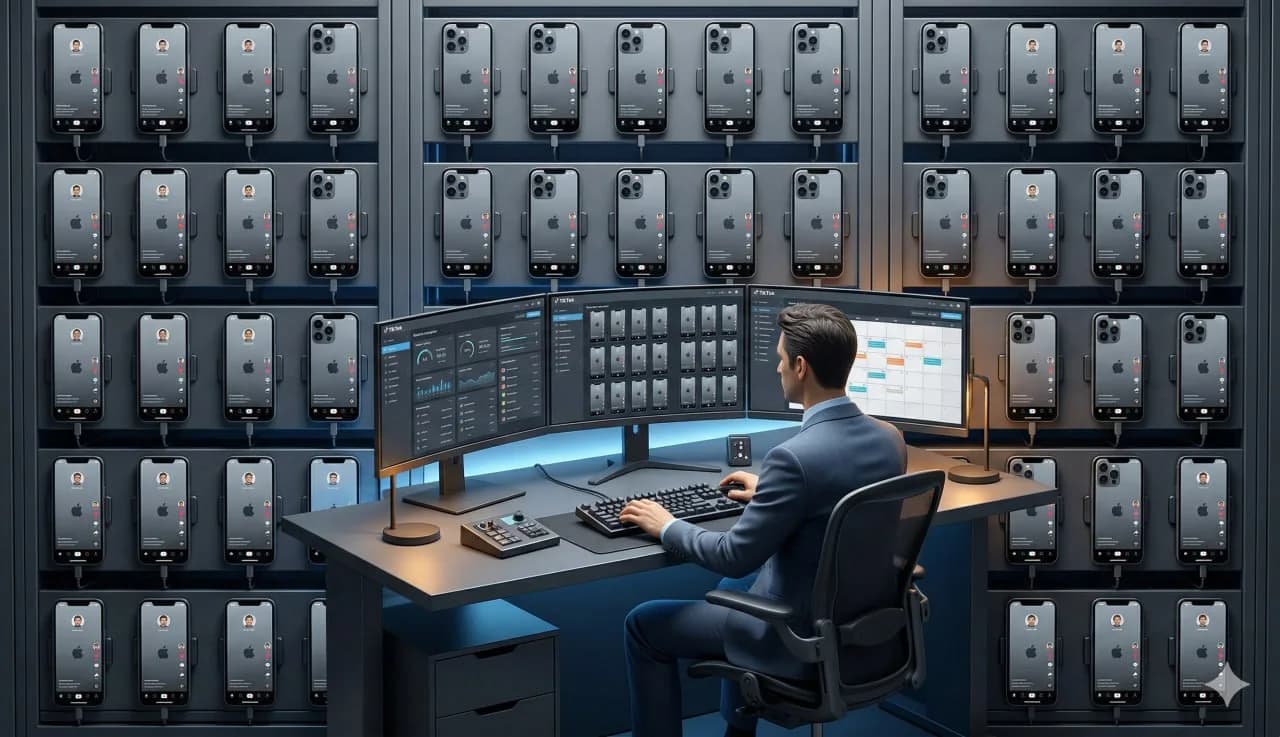
Phone Farm for TikTok: Setup, Risks, and the iPhone Advantage
Running a phone farm for TikTok can work, but only if the setup is built around real device separation, stable operator workflows, and low-risk account handling. The short version: TikTok operations are more fragile than many teams expect, and real iPhones usually give a more reliable foundation than emulators, weak Android cloud phones, or improvised local farms.
Short answer
A TikTok phone farm is a device infrastructure used to manage multiple TikTok accounts across separate phones, operators, and workflows. For serious operations, the safest setup is based on real devices, clear account-to-device assignment, controlled access, and minimal cross-contamination between accounts. In many cases, real iPhones change the equation because they reduce the instability and trust issues that often appear with emulated or low-quality Android environments.
Direct decision: what matters for TikTok phone farm at scale?
TikTok workflows are especially exposed to app behavior, media publishing patterns, warm-up, recovery and device consistency. The tool choice should start from those signals, not from a generic “multi-account” checklist.
A browser profile can help when the workload is web-heavy. An emulator can help with disposable tests. A local phone farm can help when the team wants full physical ownership. iRemotech fits when the workload needs real mobile devices, remote operators, stable sessions and less hardware burden.
Key takeaway
If your TikTok workflow depends on account longevity, repeatable operator behavior, and clean device separation, a phone farm built on real iPhones is usually the stronger option than emulators or generic cloud-phone stacks.
What TikTok operations actually require
TikTok is not just a content app. For operators, agencies, and teams managing multiple accounts, it becomes an infrastructure problem.
A workable TikTok phone farm usually needs:
- one clear device identity per account or account group
- stable login behavior over time
- predictable operator access
- low-friction switching between people or shifts
- reduced risk of account overlap, behavioral anomalies, or environment inconsistency
- enough control to scale without turning daily management into manual chaos
That is why many teams eventually outgrow ad hoc setups made of spare phones, consumer remote-control apps, or emulator-based stacks. For the control layer behind more durable operations, see Phone Farm Software.
Why weak TikTok setups fail
The most common TikTok failures do not come from one dramatic mistake. They usually come from accumulated operational noise.
1. Too many accounts touching the same environment
When teams reuse the same devices, rotate accounts too aggressively, or blur operator boundaries, the setup becomes harder to keep consistent.
2. Emulators and fake-mobile environments create instability
A system may appear cheaper at first, but if the environment does not behave like a real phone, operators often pay for it in friction, inconsistency, or account risk.
3. Local device farms become hard to manage at scale
A box full of phones can work for small experiments. It becomes much harder when the team needs remote access, predictable maintenance, and clean multi-operator workflows.
4. Poor workflow discipline creates avoidable risk
Even with good hardware, bad operating habits can still damage outcomes. Random logins, frequent resets, rushed warm-up patterns, and unclear account ownership all increase operational risk.
TikTok scale is not mainly a how many phones do I have problem. It is a consistency problem: consistent devices, consistent access, and consistent account behavior over time.
Recommended phone farm setup for TikTok
For most serious TikTok operations, the best architecture is simple in principle: use real devices, keep assignment clean, and control access centrally.
Core setup
A practical TikTok phone farm should include:
- real smartphones dedicated to TikTok use
- one account or one account cluster per device policy
- remote access for operators
- clear team permissions
- device labeling and workflow tracking
- stable network and session-handling rules
- documented warm-up, posting, and recovery procedures
Recommended structure by use case
| Use case | Typical setup need | Main risk if setup is weak | Better approach |
|---|---|---|---|
| Solo operator with a few accounts | Clean separation and simple remote access | Device reuse and sloppy switching | Real device per account path |
| Small team managing client accounts | Shared workflows and role control | Cross-account contamination | Real remote devices with clear assignment |
| TikTok growth team running many accounts | Repeatable operations and scaling discipline | Operator inconsistency and fragile tooling | Managed real-device infrastructure |
| Agency with multiple operators | Centralized oversight and device availability | Local farm chaos and maintenance burden | Remote iPhone farm with structured access |
Main risks in a TikTok phone farm
A TikTok phone farm is not risk-free. The goal is not to eliminate all risk, but to reduce avoidable failure points.
Risk table
| Risk | What causes it | Operational impact | Mitigation |
|---|---|---|---|
| Account overlap | Multiple accounts sharing devices or patterns too loosely | Trust issues, login friction, review triggers | Clear device-to-account assignment |
| Environment inconsistency | Emulators, unstable Android cloud phones, or low-quality remote layers | App instability, workflow breakdown, weaker reliability | Use real devices |
| Team access confusion | Too many people touching the same account without process | Errors, accidental changes, hard-to-trace incidents | Define operator ownership and permissions |
| Local hardware burden | DIY racks, charging problems, cable failures, manual resets | Downtime and high maintenance cost | Centralized remote infrastructure |
| Aggressive scaling behavior | Fast logins, abrupt content changes, rushed warm-up | Lower account durability | Controlled rollout and gradual ramping |
The highest-risk TikTok setup is often the one that looks cheapest on paper: mixed devices, unclear ownership, emulator shortcuts, and no operating discipline.
Why iPhone changes the equation
This is where the discussion becomes more specific. Not every phone farm is equal, and not every mobile setup behaves the same way under pressure.
Real iPhones tend to offer a cleaner operational baseline
For TikTok, real iPhones often give teams a more dependable environment because the workflow is built on actual hardware rather than simulation layers or weak substitutes.
That matters for:
- app behavior consistency
- operator trust in the environment
- lower day-to-day troubleshooting overhead
- better long-term operational repeatability
iPhone-based setups reduce some of the hidden costs of cheap scaling
A cheap setup that constantly breaks is not actually cheap. Teams lose time in:
- reconnecting devices
- handling frozen sessions
- troubleshooting access issues
- replacing unstable tools
- recovering from avoidable account problems
In practice, many operators discover that the real cost is not device price alone. It is the cost of instability.
Real iPhones are often a better fit for serious TikTok teams than generic Android cloud phones
This is especially true when the goal is not experimentation, but sustained multi-account work with real workflows, real clients, or team-based operations.
If TikTok is revenue-linked or client-facing, optimize for account durability and workflow stability, not for the cheapest nominal device layer.
How to think about the right TikTok phone farm
The right answer depends on your operating model.
A basic local setup can be enough if:
- you manage only a few accounts
- one person controls everything
- downtime is tolerable
- you do not need real team access
A real remote iPhone farm is usually better if:
- multiple operators need access
- account continuity matters
- you are scaling beyond a small test
- you need cleaner infrastructure with less manual maintenance
What to choose if TikTok risk is the real constraint
A phone farm for TikTok should be designed as operational infrastructure, not as a pile of phones with remote control added later. The more important the accounts are, the more valuable clean device separation, stable access, and real-device consistency become.
Frequently asked questions
What is the biggest mistake in multi-account work?
The biggest mistake is treating accounts as isolated logins instead of operating environments. Platforms look at the device, network, app behavior, recovery patterns and how accounts cluster over time.
Do proxies solve the problem by themselves?
No. Proxies help with network separation, but they do not fix weak device identity, emulator signals, erratic operator behavior or poor account warm-up.
When should a team use one device per account?
Use one device per account when the account has real value, needs long-term continuity or operates in a platform where device trust is part of the risk model.
How should new accounts be warmed up?
Warm them gradually. Keep the device and network stable, avoid aggressive first-day actions, and make the account behavior look like a real operator is building a routine.
Stop juggling physical devices.
iRemotech gives you real iPhones in the cloud — ready for multi-account operations, automation, and scale. Create your account in minutes.
Sign up freeMiguel Nogales
Founder @ iRemotech
From Spain, living in Andorra. Tech enthusiast passionate about infrastructure, remote technology, and building innovative solutions.