DuoPlus Alternative: The Real ARM Cloud Phone Comparison
Looking for a DuoPlus alternative? Compare ARM cloud phones vs real devices and see when virtual mobile environments stop being enough for serious operations.
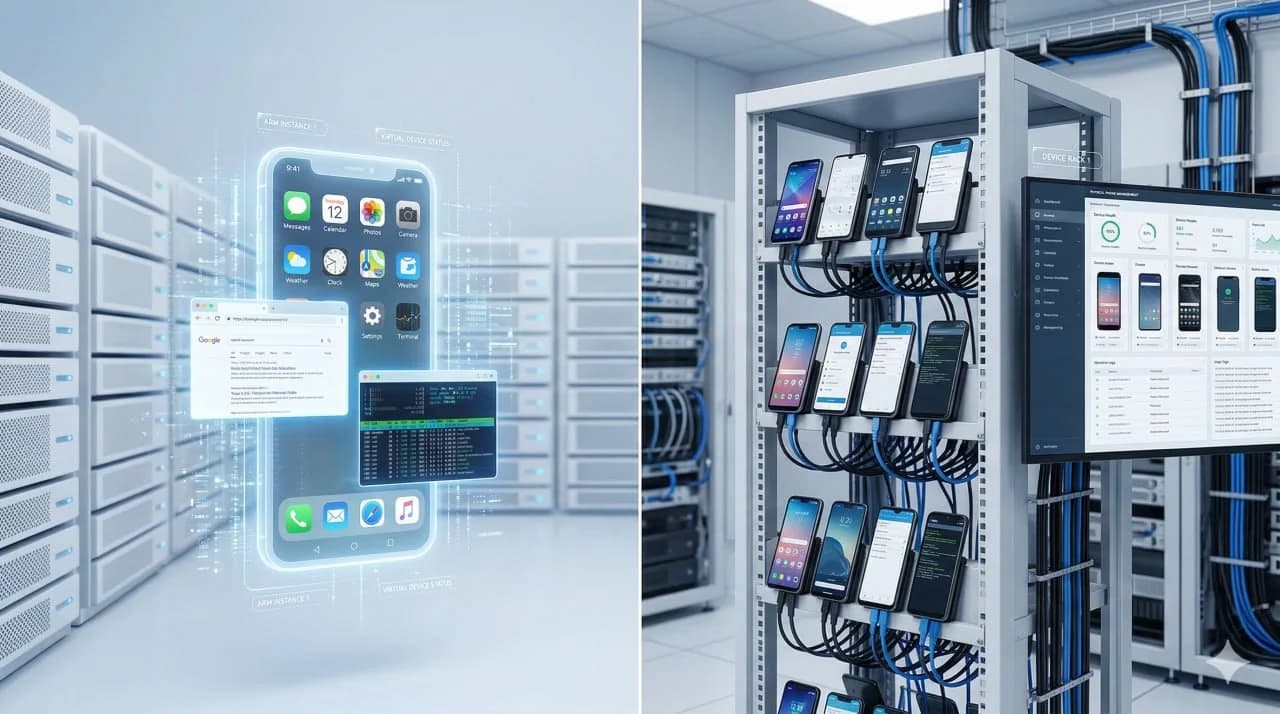
Key takeaway: ARM cloud phones solve part of the problem, mainly remote access and mobile app availability, but they do not turn a virtualized environment into real hardware. That difference matters when stability, trust signals, and long-term account operations are important.
Decision answer: when should you move beyond DuoPlus?
DuoPlus can make sense when the team wants fast Android-style cloud access, short-lived testing environments or a lower-friction way to run app sessions. The limitation appears when the account needs to look and behave like it belongs to a stable physical iPhone over time.
Use DuoPlus for Android-first workflows, short tests, research accounts or situations where OS trust is not the deciding factor. Consider iRemotech when the account value justifies real iPhones, iOS-specific behavior, stronger recovery continuity, media workflows and an operator model that should not depend on local racks.
The extraction point for buyers is this: Android cloud convenience and physical iPhone trust are different layers. If the commercial risk is account durability, recovery and iOS credibility, the shortlist should compare real-device infrastructure directly instead of treating all cloud phones as interchangeable.
What DuoPlus is
DuoPlus sits in the ARM cloud phone category. In practical terms, that means it gives users remote access to Android-like mobile environments hosted in the cloud.
For some teams, that is enough. It can be useful when you want:
quick deployment
remote access from anywhere
less physical hardware on-site
easier account compartmentalization than using a single local phone
This is why ARM cloud phones are often considered by operators managing social apps, testing flows, or basic mobile workflows.
If you need a broader definition of the category first, see What Is a Cloud Phone?.
What ARM cloud phones solve well
ARM cloud phones are not useless. They solve several real problems.
Faster provisioning
You can launch environments faster than buying, connecting, charging, labeling, and managing physical devices one by one.
Lower hardware handling overhead
There is less hands-on device maintenance. You do not need shelves of phones for every use case.
Easier remote teamwork
Distributed teams can access the same infrastructure without being physically near a device rack.
ARM cloud phones make sense when your priority is convenience, rapid deployment, and lightweight mobile access rather than maximum hardware realism.
What they still do not solve
This is the core issue for anyone comparing DuoPlus with a real-device alternative.
An ARM cloud phone is still a cloud-hosted virtualized environment. Even if it runs mobile apps and imitates phone behavior better than a browser profile or emulator, it is still not the same thing as a real phone with real hardware.
They are not real hardware
This is the main line that should stay clear: ARM cloud phones are still not real devices.
That affects how some workflows behave over time, especially when apps or platforms are sensitive to device consistency, hardware-level signals, or long-lived account trust.
For a deeper comparison, see Android Cloud Phone vs Real iPhone.
App behavior can still differ from physical-device reality
Many mobile apps run on ARM cloud environments. That does not mean they behave exactly like they would on an actual phone in a real operating context.
The gap may show up in:
background behavior
session consistency
update handling
device trust patterns
long-term account durability
Scaling quality is different from scaling authenticity
Cloud scale is easy to advertise. Authenticity is harder.
A provider can give you many instances quickly, but if the environment is still virtualized, you are scaling virtualized devices, not real phones. That is a meaningful distinction for operations where trust, consistency, and device realism affect outcomes.
“ARM-based” does not mean “physical.” A cloud phone built on ARM architecture is still a virtual environment unless it behaves like an actual device in practice.
DuoPlus vs real-device infrastructure
Below is the practical comparison most buyers actually need.
| Factor | DuoPlus / ARM cloud phone | Real-device infrastructure |
|---|---|---|
| Device type | Virtualized mobile environment | Physical phone hardware |
| Setup speed | Fast | Slower at first |
| Physical maintenance | Low | Higher |
| Hardware authenticity | Limited | High |
| App behavior realism | Medium | High |
| Long-term account operations | Can be inconsistent depending on use case | Generally stronger |
| Remote access | Strong | Strong if properly managed |
| Best for | Convenience-first mobile access | Reliability-first mobile operations |
When DuoPlus is enough
DuoPlus may still be a reasonable choice if your workflow is mostly about:
basic remote app access
short-cycle testing
lightweight mobile tasks
convenience over authenticity
reducing physical device handling
If your use case is simple, ARM cloud phones can be good enough.
When a DuoPlus alternative makes more sense
A real-device alternative makes more sense when your workflow depends on stronger device credibility and more predictable app behavior.
Choose a real-device setup if you need:
real phone hardware, not virtualized instances
higher confidence in mobile-native behavior
infrastructure for serious multi-device operations
better fit for long-term account management
a cleaner path from small-scale testing to larger production use For TikTok-specific execution, Phone Farm for TikTok breaks down the real-device setup requirements.
If your operation depends on trust, consistency, and true device behavior, the better DuoPlus alternative is not another ARM cloud phone. It is a platform built around real devices.
ARM cloud phone vs real device: the decision framework
If you are deciding quickly, use this rule:
Pick an ARM cloud phone if:
you need speed more than realism
you want minimal hardware handling
your workflows are tolerant of virtualized environments
Pick real devices if:
device authenticity matters
app behavior must match real-world phone conditions
you are building a serious long-term operation
you want infrastructure that scales without relying on “close enough” device simulation
When a real-device alternative becomes the better fit
DuoPlus is not the wrong tool. It is just the wrong category for some buyers.
If you want remote mobile access with lower hardware overhead, an ARM cloud phone can work. But if you are specifically looking for a DuoPlus alternative because you need something closer to real device behavior, the answer is straightforward: an ARM cloud phone still does not become real hardware just because it runs mobile apps in the cloud.
That is why the strongest alternative is usually a real-device platform, not another virtual phone stack.
Frequently asked questions
When is a browser-profile tool no longer enough?
It stops being enough when the work has moved from web sessions into native mobile apps. At that point the browser fingerprint is only one signal; the device, OS, network, SIM profile and account behavior all start to matter.
Does every team need real iPhones?
No. Low-risk testing and browser-first workflows can stay cheaper. Real iPhones make sense when account value, iOS behavior, long-term stability or platform trust matter more than the lowest monthly device cost.
What should I check before moving from an antidetect stack?
Check where the actual work happens. If operators spend most of the day inside TikTok, Instagram, WhatsApp or another mobile app, evaluate the mobile environment first and the browser layer second.
How should a team migrate without breaking current accounts?
Move in batches. Keep high-value accounts on stable devices, avoid sudden network and behavior changes, and only scale once the first group has a clean operating routine.
Stop juggling physical devices.
iRemotech gives you real iPhones in the cloud — ready for multi-account operations, automation, and scale. Create your account in minutes.
Sign up freeMiguel Nogales
Founder @ iRemotech
From Spain, living in Andorra. Tech enthusiast passionate about infrastructure, remote technology, and building innovative solutions.