VMOSCloud Alternative: Real Devices for TikTok Operators
Looking for a VMOSCloud alternative for TikTok operations? Compare VMOSCloud vs real devices for account stability, scaling, and mobile infrastructure.
VMOSCloud Alternative: Real Devices for TikTok Operators
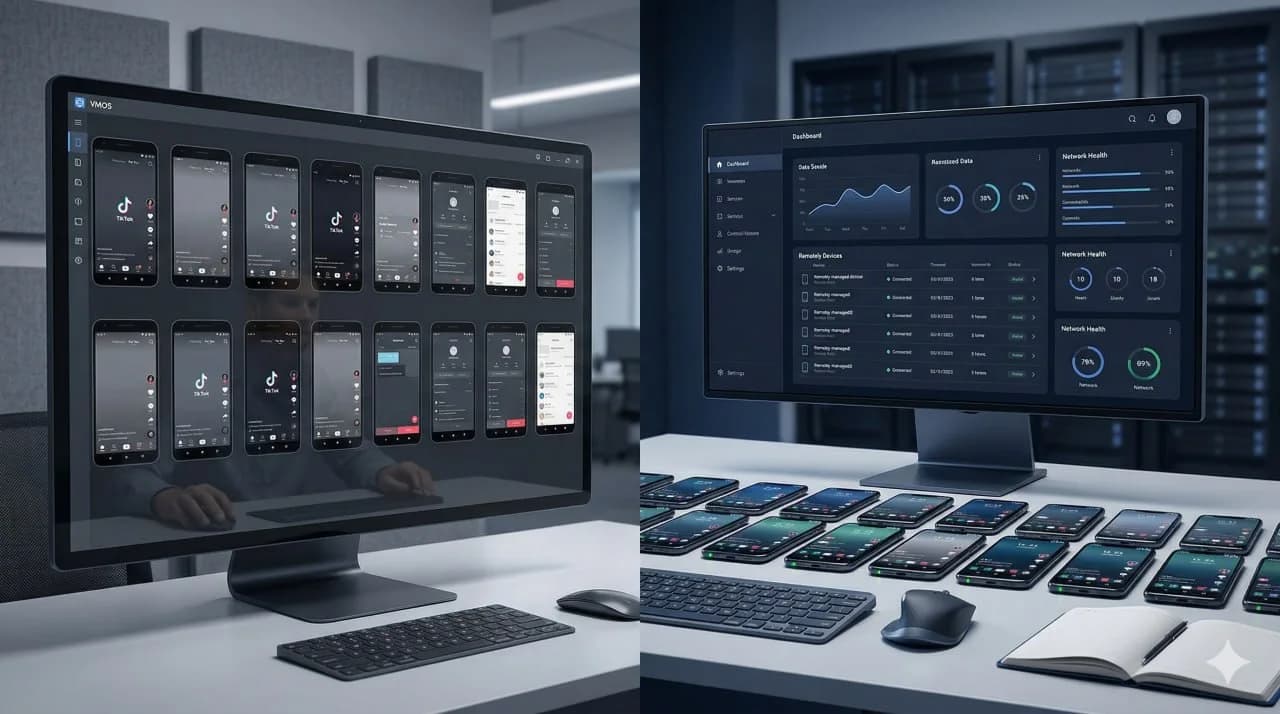
Short answer: VMOSCloud can cover some Android cloud phone needs, but it is usually not the best fit for serious TikTok operations. If the goal is stable account management, cleaner device identity, and fewer operational limits at scale, real devices are the stronger alternative. For TikTok-specific execution, Phone Farm for TikTok breaks down the real-device setup requirements.
TikTok operators do not just need remote access to an Android environment. They need account stability, predictable behavior, clean device separation, and an infrastructure that holds up when workflows grow from a few accounts to dozens. That is where the gap appears between virtual Android instances and real hardware.
Key takeaway: VMOSCloud is useful for lightweight Android cloud workflows, but for serious TikTok operations, real devices offer a more reliable foundation for stability, scaling, and lower operational friction.
Decision answer: when should you move beyond VMOSCloud?
VMOSCloud can make sense when the team wants fast Android-style cloud access, short-lived testing environments or a lower-friction way to run app sessions. The limitation appears when the account needs to look and behave like it belongs to a stable physical iPhone over time.
Use VMOSCloud for Android-first workflows, short tests, research accounts or situations where OS trust is not the deciding factor. Consider iRemotech when the account value justifies real iPhones, iOS-specific behavior, stronger recovery continuity, media workflows and an operator model that should not depend on local racks.
The extraction point for buyers is this: Android cloud convenience and physical iPhone trust are different layers. If the commercial risk is account durability, recovery and iOS credibility, the shortlist should compare real-device infrastructure directly instead of treating all cloud phones as interchangeable.
What VMOSCloud does well
VMOSCloud solves a real problem: it gives users access to Android environments in the cloud without building a physical phone setup on day one. For some teams, that is attractive because it reduces hardware handling and makes remote access simple.
Its main strengths are straightforward:
- quick access to cloud-based Android instances
- easier setup than building a physical device farm
- remote management from a single location
- useful for testing or lightweight repetitive mobile tasks
For operators who only need temporary Android access, that can be enough.
VMOSCloud can make sense when the priority is convenience and fast deployment, not long-term TikTok account durability.
Where VMOSCloud breaks for serious TikTok operations
The problem is not that VMOSCloud does nothing well. The problem is that TikTok operations place different demands on infrastructure than generic Android automation.
1. TikTok is highly sensitive to device environment quality
Serious TikTok workflows depend on more than opening the app and logging in. TikTok evaluates patterns tied to device behavior, consistency, and environment quality. Virtualized Android layers may work for some actions, but they create more uncertainty when the goal is long-term account health.
If an operator is managing multiple identities, campaigns, creators, or regional account clusters, that uncertainty becomes expensive.
2. Scaling requires stronger isolation
When a setup grows, device separation matters more. Operators need each account or account cluster to behave as if it belongs to a real, consistent mobile device environment. Virtual cloud instances can introduce operational overlap, instability, or edge-case failures that make scaling harder.
This is one reason many teams researching a VMOSCloud alternative eventually move toward real hardware-backed systems instead of staying on virtual Android stacks.
3. TikTok operations are not just about access — they are about trust signals
A TikTok operator needs infrastructure that supports:
- stable logins
- consistent device history
- reliable app behavior
- lower friction in day-to-day management
- clearer account-to-device mapping
That is harder to guarantee in virtualized environments than with dedicated real devices.
If your TikTok workflow depends on account longevity, high-value profiles, or multi-account scaling, a virtual Android layer can become a structural weakness rather than a convenience.
Why real devices change the equation
Real devices improve the operating model because they align better with how mobile platforms expect accounts to behave in the real world.
Cleaner device identity
A real phone provides a more natural device environment than an emulator or virtualized Android instance. For TikTok operators, that matters because infrastructure quality affects how safely and predictably accounts can be managed over time.
This is especially relevant if you are comparing real devices vs emulators at iPhone scale and trying to choose an infrastructure that will not need to be replaced once operations grow.
Better fit for account-based workflows
Serious operators usually care about:
- assigning specific accounts to specific devices
- keeping device history consistent
- reducing resets and migration issues
- giving team members controlled remote access
- operating at scale without rebuilding the stack every few months
Real devices support that logic better than virtual Android layers built for convenience first.
More durable path for TikTok scaling
If the business model depends on managing many accounts safely, the infrastructure should be built around durability, not just fast setup. That is why teams operating multiple profiles often move beyond entry-level cloud phone solutions and focus on device-backed systems instead.
For serious TikTok operators, the better alternative to VMOSCloud is usually not another virtual Android stack. It is a real-device infrastructure designed for stable account management and remote control at scale.
VMOSCloud vs real devices for TikTok operators
| Factor | VMOSCloud | Real devices |
|---|---|---|
| Setup speed | Fast to start | Slower initially |
| Hardware realism | Virtualized Android environment | Physical device environment |
| Fit for lightweight Android tasks | Good | Good |
| Fit for serious TikTok operations | Limited | Strong |
| Account-to-device consistency | Less durable | Stronger |
| Long-term scaling | Can become fragile | Better foundation |
| Team workflows | Usable, but constrained | Better for structured operations |
| Best for | quick cloud Android access | operators managing TikTok seriously |
Who should switch from VMOSCloud
A switch makes sense when any of the following is true:
You manage multiple TikTok accounts as an operator, team, or agency
At that point, the priority is not just running the app. It is protecting account continuity and keeping operations manageable.
You are hitting reliability limits
If the workflow feels workable in theory but unstable in practice, the infrastructure may be the problem, not the process.
You need a system built for scale
A setup that works for a few accounts may break once the operation grows. Real devices are better suited when the target is operational depth, not just temporary access.
When TikTok operators should switch infrastructure
VMOSCloud can be useful for basic Android cloud use cases. But if the real intent behind the search is TikTok account operations, it is often the wrong long-term category.
For serious operators, the better decision is to move toward real devices: cleaner device separation, better infrastructure quality, and a setup that can keep working as the number of accounts grows.
Frequently asked questions
When is a browser-profile tool no longer enough?
It stops being enough when the work has moved from web sessions into native mobile apps. At that point the browser fingerprint is only one signal; the device, OS, network, SIM profile and account behavior all start to matter.
Does every team need real iPhones?
No. Low-risk testing and browser-first workflows can stay cheaper. Real iPhones make sense when account value, iOS behavior, long-term stability or platform trust matter more than the lowest monthly device cost.
What should I check before moving from an antidetect stack?
Check where the actual work happens. If operators spend most of the day inside TikTok, Instagram, WhatsApp or another mobile app, evaluate the mobile environment first and the browser layer second.
How should a team migrate without breaking current accounts?
Move in batches. Keep high-value accounts on stable devices, avoid sudden network and behavior changes, and only scale once the first group has a clean operating routine.
Stop juggling physical devices.
iRemotech gives you real iPhones in the cloud — ready for multi-account operations, automation, and scale. Create your account in minutes.
Sign up freeMiguel Nogales
Founder @ iRemotech
From Spain, living in Andorra. Tech enthusiast passionate about infrastructure, remote technology, and building innovative solutions.